Learn English and Improve Your Accent Through Music
Music is not only a form of entertainment but also a great tool for learning languages. One of the most popular languages in the world is English, and many people want to improve their English skills. Listening to and singing English songs can be a fun and effective way to learn the language and improve your accent. In this article, we will discuss how to use music to learn English and improve your accent.
Download the music and lyrics
The first step is to download the music and lyrics of the songs you want to learn. You can find the lyrics on various websites or use music apps that provide the lyrics along with the song. Once you have the lyrics, it's essential to find the meaning of all the words you don't know using a dictionary. This will help you understand the lyrics and learn new vocabulary.
Music is useful to learn vocabulary and expressions
Music is an excellent way to learn vocabulary and expressions in context. You can learn new words and phrases by listening to English songs and paying attention to the lyrics. For example, if you listen to a love song, you will likely hear words like "heart," "soulmate," and "romance." If you listen to a rap song, you will likely hear words and expressions related to urban life and culture.
Sing out loud
As you listen to the music, it's essential to sing out loud together with the singer. This will help you get used to producing the sounds of the English language and improve your accent. Don't worry about making mistakes; the important thing is to practice and have fun. You can also try to mimic the singer's pronunciation and intonation to improve your accent.
Learn one song per week
Learning and practicing one song per week is an effective way to learn English through music. In one year, you will learn 52 songs, which is a lot of learning and vocabulary to add to your repertoire. You can create a playlist of your favorite English songs and practice them regularly. It's also a good idea to listen to the songs in different genres to learn new vocabulary and expressions.

Lesson in Using Music to Learn English (YouTube / YouKu)
Truly, there is no better or more enjoyable way to enhance your English skills than by using music. This method is not only straightforward and effective, but it also requires no specialized skills to implement. If you're wondering why listening to English songs hasn't helped you improve your language abilities, it's possible that you overlooked some essential steps. To get the most out of this method, you need to learn the lyrics and their meanings, as well as sing along while the music is playing. However, the most crucial component of this process is having fun while doing it. It has been proven that students learn most effectively when they are enjoying the learning process.
In conclusion, music is a fun and effective way to learn English and improve your accent. By downloading the music and lyrics, learning new vocabulary and expressions, singing out loud, and learning one song per week, you can enhance your English skills and add new words and phrases to your repertoire. So, turn up the volume and start learning English through music today!
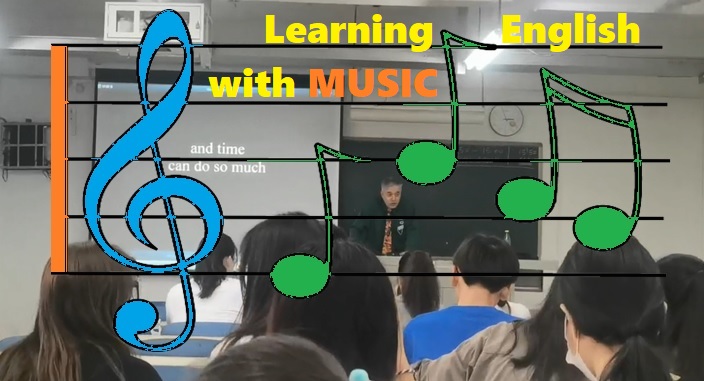
Here I was demonstrating how it that to be done to my students Perhaps I just make fun of myself. ha ha ha…
# E05 zhanglulu 1119 # I did write a review of this post from my teacher, here is my review:
To be honest, whenever I think about learning English, the first images that come to mind are thick vocabulary books and endless grammar exercises. To learn English well, you have to sit at your desk, memorizing word lists, desperately trying to cram "abandon" into your brain — only to abandon it a week later. Grammar? Don't even get me started. It's just so frustrating. After reading my teacher's article about learning English through music, something suddenly clicked. Wait — learning English can actually be enjoyable? Just by listening to songs I already love? That sounds way too good to be true. It made me reflect deeply on my own language learning journey over the years. Looking back, I realize my approach was always quite traditional and rigid. I spent countless hours with thick vocabulary books, trying to force words into my long-term memory through sheer repetition. I also struggled through grammar books, attempting to understand complex rules without any meaningful context. While these methods did help me build a foundation, they also made me lose interest in English learning, and even develop a bit of fear. After all, so much effort for so little reward — the learning experience was far from enjoyable. It felt like a chore, not something to look forward to. What struck me most about the article was its central idea: English learning can be naturally integrated with activities we already enjoy. As the article points out, music is not just entertainment — it's actually a powerful learning tool. When we genuinely love doing something, it never feels boring or scary; it feels enjoyable. Similarly, when we repeatedly listen to a song because we truly like it, the lyrics naturally become familiar to us. We absorb vocabulary, sentence structures, and even cultural nuances without the stress of conscious memorization. Moreover, singing along helps develop a more natural accent and improves pronunciation — aspects of language learning that traditional textbook study often fails to address. This realization has encouraged me to rethink my approach. I plan to incorporate music into my regular English learning routine. For example, I might select one English song each week, study its lyrics thoroughly, and practice singing it until I feel comfortable with both the pronunciation and the meaning behind the words. Over time, I believe this consistent exposure will help me internalize authentic expressions and improve my listening comprehension in a more organic way. Beyond music, I realize this principle applies to other forms of media as well. Watching English-language movies and TV series, for instance, offers another valuable opportunity for immersive learning. Through films and shows, we are exposed to natural conversations, diverse accents, and real-life contexts that textbooks simply cannot replicate. We can observe how native speakers express emotions, tell jokes, and handle everyday situations. This not only enhances our language skills but also deepens our understanding of the culture behind the language. My teacher's article has reminded me that language learning doesn't have to be confined to classrooms and textbooks. We should broaden our perspective and combine English learning with our personal interests. By doing so, we can make the process more relaxing and enjoyable, boost our confidence, and truly appreciate the charm of the English language. By integrating music, movies, and other media into my learning strategy, I hope to transform English from a subject to be studied into a living language to be experienced.

Article by Marcelo Gameiro
Published 03 Mar 2023